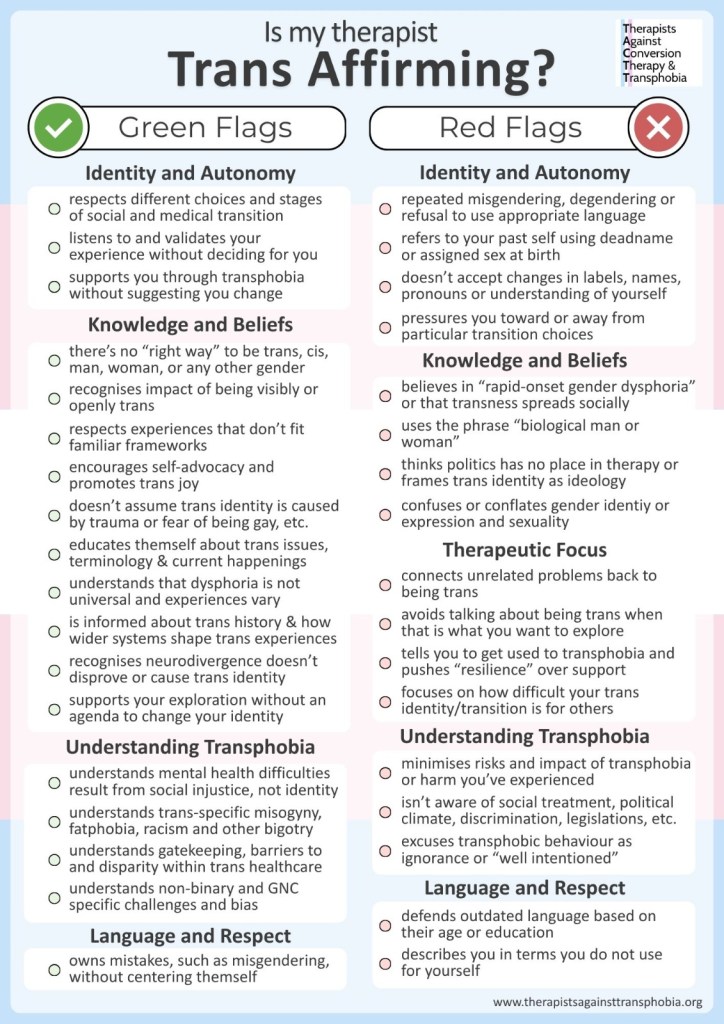
We recently shared our new trans-affirming therapist checklist in the form of images which can be shared and referred to. Here, we are sharing a longer version of the checklist with more detailed points for consideration, and some suggested questions you could ask a potential therapist or reflect on yourself.
This guide is for anyone who is looking for a trans-affirming therapist. It might be useful to you when you are looking for therapy if you are trans or non-binary, or a loved one is, or you are exploring your gender.
It may also be useful for therapists who are thinking about how to increase their cultural competence when working with trans, non-binary, and gender exploring clients (if that’s you, we also suggest checking out our resources page). We start by giving a green flag list and we suggest that a therapist who is competent to work with trans topics is familiar with most, if not all of these concepts. Then we give a list of red flags and suggest that if a therapist says these things to you, that you exercise caution around having therapy with them.
Underneath we have given a set of questions you can ask of a therapist. A trans-friendly (affirming) therapist should be able to answer these questions without reacting defensively, whatever their counselling/psychotherapy approach is. Inspiration for this checklist came from Sonny Jane Wise’s checklist https://www.livedexperienceeducator.com/s/Is-your-provider-neurodiversity-affirming-1.pdf
Therapist Green Flags:
Listens to you and validates your experience without trying to be the expert on your life.
Supports you to decide what is important to you, and what you want to work on.
Accepts that being transgender is not better or worse than being cisgender, and doesn’t believe there’s a correct way to be any particular gender.
Understands the diversity of the trans umbrella and that each person’s experience of being trans is valid, no matter how unusual the label or description may be. Understands that a western/ European perspective is only one way to understand being trans and that not everyone fits within this.
Encourages self-advocacy and is able to talk about and promote trans joy, not just the absence of trans suffering.
Can work with distress related to being trans (e.g. dysphoria and discrimination) without trying to convince you it’s better to live as the sex you were assigned at birth.
Doesn’t believe that trans people are trying to avoid being ‘gay’, or are trans because they were abused.
Understands that the mental health struggles trans people can experience are often due to how trans people are treated in society and not an inherent part of being trans.
Accepts that some trans people are neurodivergent, and that any neurodivergence does not negate your trans identity.
Understands that being a trans woman or a trans man is a different experience than being a cisgender woman or a cisgender man, especially if you’re often perceived as trans. As a result, trans people can experience specific types of discrimination and hostility, which can lead the person (especially trans women) to be in danger simply whilst existing in the world.
Understands the specific challenges that non-binary and gender non-conforming people face including lack of legal recognition for non-binary identities, erasure of their experiences, and bias when seeking transition care.
Situates trans identity within other systems of power such as colonialism, capitalism, patriarchy, and has an understanding of the history of trans identities.
Recognises that other aspects of identity (such as race, class, age, disability, access to money) will interact with and impact on your experiences as well as your ability to access a medical transition (whether private or NHS).
Recognises the complexity and disparity between private and NHS trans healthcare and the devastating impact of spending years on NHS waiting lists in order to access vital health care.
Understands the complexity of fatphobia in trans experience including medical gatekeeping due to BMI, mandated weight loss which may or may not be possible or desired and gendered expectations around body size/shape.
Understands that there are many reasons why you may choose not to or be unable to follow a medical transition path. Recognises you as a valid trans person regardless of who you are ‘out’ to or what kind of transition steps you have taken. Doesn’t pathologise you if you’re a ‘stealth’ trans person.
Understands that not all trans people will describe, or understand themselves as having dysphoria, and that there is a difference between physical, and social dysphoria. Doesn’t assume that all body related discomfort is dysphoria.
Avoids misgendering and takes active responsibility for it if/when they do without making you feel responsible for their feelings.
Actively educates themself on trans topics (and correct language use).
Understands and can discuss with you the differences between conversion therapy and affirmative therapy.
Is aware that all therapy is exploratory, but that the specific term ‘exploratory therapy’ may indicate a pathologising stance towards trans experience.
Therapist Red Flags:
Believes in “rapid onset gender dysphoria” and/or social contagion of transness
Uses statements such as ‘biological man/woman’ and/or suggests that a trans woman is “biologically male” or that a trans man is “biologically female”.
Uses the word “ideology” only about transgender topics, (rather than recognising that an ideology is a set of beliefs that people hold about any number of topics).
Tells you that you should come out to people, even if you’re not ready or you don’t feel you have people you can trust.
Misgenders you/other trans people frequently (and doesn’t understand the damage caused), or uses ‘they/them’ or other “neutral” language to avoid using your gendered language.
When discussing a pre-transition childhood, insists on referring to you as your assigned sex, or if they know it, any name you no longer use.
Accepts binary and gender conforming trans people but thinks that non-binary/genderqueer people are somehow ‘confused’ or unwell, or are in denial about their binary trans (or cis) status.
Tries to push you into, or away from a particular medical pathway. For example suggesting you need more time in therapy before moving on to a waiting list/starting medical intervention or social transition, or suggesting that you shouldn’t transition without more social support. They may also steer you away from ‘permanent’ changes such as hormones or surgery and towards alternatives like new clothing or hairstyles.
Doesn’t recognise the impact of transphobia, lacks real understanding of the current climate for trans people, isn’t informed about current guidance and legislation.
Minimises the harm you’ve been caused as a result of others’ transphobia (for example, family members, friends and previous therapists who may not have meant to be transphobic but who have nonetheless caused harm by expressing their problematic opinions)
Focuses on how hard it must be for other people in your life to adjust to your new identity/new pronouns etc.
Pressures you to become more resilient, because you need to ‘get used to transphobia’ (unless that’s what you specifically asked to work on).
Focuses too much on trans/gender identity and connects every issue back to that, whether or not it is relevant to the issues you are actually wanting to discuss.
Makes assumptions about your sexual orientation from either your gender or presentation. Conflates or confuses sexual orientation and gender identity.
Uses outdated language (such as ‘transsexual’) when those weren’t your words, and doesn’t update their language.
Questions for a potential therapist and for self-reflection:
Below are some questions to ask any potential therapist in a first conversation, and some questions for your own reflection. The questions are either adapted from or copied from https://pinktherapy.com/choosing-a-therapist/ which in turn are adapted from this book https://www.goodreads.com/book/show/1344528
Questions for a potential therapist
What is your understanding of conversion therapy, affirmative therapy and exploratory therapy and how do these differ?
Are you willing to accept that I am the expert of my experience, even if it feels difficult to understand?
What is your understanding of transgender as an umbrella term?
How do you understand dysphoria?
Do you believe an openly trans person can live a rich and satisfying life?
How do you generally work with trans people?
What work have you done to explore any of your own anti-trans bias?
What is your understanding of the legal situation around trans people in the UK (for example the 2026 EHRC toilet guidance)?
How does transphobia impact trans people?
What books or CPD have you utilised when working with trans people?
When did you last attend any training around working with gender divergence?
What reflection and work have you done on your own gender?
Have you worked with other trans clients?
Questions to check in with yourself about afterwards:
Did their values feel compatible with yours?
Did you feel understood?
Did you have an initial feeling of trust in the therapist?
Did you feel respected by the therapist?
Were they sensitive to your feelings?
Did you feel a sense of warmth, or liking towards or from the therapist?
Did anything make you feel uncomfortable?
Were you able to be yourself?
Did you feel a need to hide anything?
Did you get any feedback from the therapist? Was it helpful? Insightful?
Did you come away with any greater understanding of yourself than you had before the first meeting?
Did you disagree with the therapist at any point? How did that go? Was the therapist defensive?
Were you invited to ask any questions about the therapy process? How were these answered?
How do you feel about speaking to them again?