The mental and emotional toll of not being seen in training.

A member writes…

I’m a quarter of the way through my supervision training, and I’m having a strong sense of déjà vu. The coursework is intense, with much material to cover between classes. I’m strategising to make time within a busy work week to cover all the pre-class learning, much as I did when I studied my level 4 counselling diploma. I’m back in triads, practicing skills with classmates as we work through the theory we are all studying together. There’s a lot of discussion in the group chat about things that are coming up in the reading and reflections on what we’re learning. 

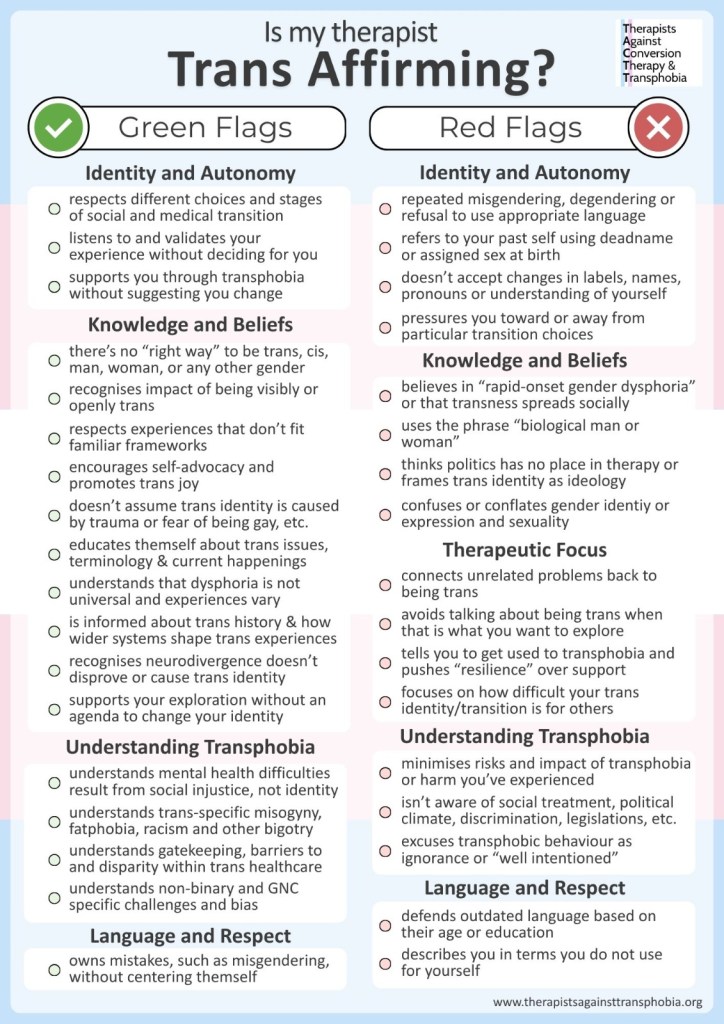
These aren’t the main things causing the sense of similarity, though. The feeling of history repeating comes from the fact that, in spite of having my pronouns clearly marked next to my name in the online learning platform and the group chat, so far no-one has referred to me using the correct ones.

Plus ça change, plus c’est la meme chose

In some ways, things are different. This course is different. We are all qualified and experienced therapists with at least a few years of therapy under our belts, in some cases many more years than that. 

We are also doing the course online and, although I completed the last two modules of my Level 4 online at the start of the pandemic, I did most of my counselling training in-person where I could share physical space with classmates and talk between teaching. The supervision course is quite rightfully enforcing screen breaks between teaching sessions on the classroom days. However, this means that you don’t get to talk to classmates informally.

The supervision course is communicating very clearly that it is aware of diversity. On the pre-recorded lecturers, the tutor is careful to point out the sexist nature of a lot of the idioms that are used in common parlance and is clearly taking care to refer to men, women, and people outside that binary. They invite people to approach them with any accommodations they could make for disability or neurodivergence. They are, in short, doing more than my Level 4 ever attempted. 

I made it clear that I was non-binary and used they/them pronouns with my diploma tutors and classmates on multiple occasions and, after the only other queer participant left after level 3, not a single person ever used my pronouns. My first interaction with people on the supervision course was at our first session where we were split into breakout groups to discuss hopes and fears for the course and one of the people in my group recognised my name from the group chat (where I also have my pronouns next to my name) and cried “oh! You’re the lady with the lovely dog in your profile picture!” Having spent most of my professional life working with queer and trans colleagues and clients for the past six years, I was so taken aback that I didn’t say anything.

Since then, not a single person has used the correct pronouns for me. I’ve had 12 hours of contact time so far. I have 24 hours to go. By the end of the second virtual classroom day, I was so exhausted, I immediately lay down and fell into a dreamless sleep.

Death by a thousand cuts

In my day-to-day life, I don’t really care what pronouns people who don’t really know me use to refer to me. I know that to a lot of people, I look like a middle-aged woman. I find it sort-of surprising when people refer to me with she/her pronouns, in the sense that I have a tendency to look over my shoulder for who they’re talking about, then realise it’s me. Even so, I don’t find it upsetting. I don’t expect people to know what I haven’t told them, and I don’t want to spend the whole of my life having conversations with shop assistants about gender.

It feels significantly different when it’s in a context where I’m surrounded by professionals who have been trained in entering someone else’s frame of reference and showing them respect and positive regard. The participant who called me “the lady with the dog” is the only person so far I’ve responded to and asserted my gender and pronouns. The response was to say “oh, I think someone told me about non-binary” without apologising or changing anything.

Since then, no-one has used the correct pronouns in any of the feedback from triads, which is the main place where I’m finding myself referred to in the third person. We are usually rushing through the practice and feedback so we can get as much out of the time as possible. 

The microaggressions and microinvalidations really do feel like death by a thousand cuts. No-one is being overtly horrible to me. Everyone I have directly interacted with so far is otherwise caring and considerate. I don’t feel like anyone is deliberately trying to upset me. There’s no sense that I’m surrounded by gender-critical people trying to make a point. I just don’t feel seen or acknowledged. It’s making me feel like I’m losing my mind. 

It takes so much more energy to do training that is already very intense when I’m also taking emotional damage. It is hard to describe the weight I feel going into the sessions knowing that I’m not going to be seen. Even though I have had specialist training in working with queer and trans people and have read studies on the impact of microaggressions and microinvalidations, I simultaneously feel angry and like I’m making a fuss about nothing. 

I am carrying an emotional weight into the sessions that impacts my ability to participate in the work. It’s infuriating. As I put in my feedback from the most recent teaching day, it is adding to my cognitive and emotional load to be in an environment where my obviously displayed pronouns aren’t being used by anyone I’m interacting with. We have so little time in the breakout sessions that I don’t want to mention it. I don’t want to use the limited time we have to discuss skills practice on educating people about gender or managing other people’s emotions about being pulled up on getting it wrong. It’s making me dread going to the sessions instead of enjoying them and letting myself be myself freely, making mistakes and learning from them. 

I feel sad. For myself, for the trainee counsellors all over the country who may also be carrying this additional emotional weight, and for the countless clients of so many counsellors who may experience similar invalidation. I wish I had answers, but I don’t want to add to the burden of other people going through this by offering suggestions on how to call your colleagues out, and I am in no position to influence training organisations to do things differently. I am now in a position where I feel like this might be the last such qualification-focused course I do in my career, because I simply don’t have the energy to manage the ongoing emotional impact.

Reasonable adjustments in placements

Recently one of our members wrote an open letter to the membership bodies asking for online placements to be considered a reasonable adjustment for disabled trainees.

Very briefly, the letter argues that not all placements will be accessible, which leaves some trainees on a training course that requires a placement that the trainee must find for themselves, but a placement has no requirement to make itself accessible, and the membership bodies refuse to accept a wholly online placement even if there is no physical placement accessible to the student. This means that the trainee is stuck in an impossible situation of not being able to qualify without a placement, and not being able to physically enter a placement to qualify, whilst not being allowed to complete a placement that would give them the hours. 

It is worth signing on that basis alone, however, we want to talk here about the recent high court decisions that will impact trans trainees. Whilst reasonable adjustments are usually thought of as being something ‘for disability’, what we are actually talking about here in relation to this issue with BACP,  is an ‘access need’. What do students whose access to placement is limited or non-existent as a result of a protected characteristic need in structural terms in order to complete their placements?

Let us create a fictional person for you and demonstrate. 

Marie is a 32 year old trans woman who has five or six placements available in her local area (within an hour’s drive). She has had excellent feedback on her skills practice. Her tutors are telling her they are looking forward to her going into placement next month. She has obtained her readiness to practice and shows herself to be an excellent trainee. Three of the placements in her area are in the subject area that she would like to specialise in, but she would happily accept a placement in any of these and is in the process of interviewing. 

Marie is sometimes read as trans, but not always. She does not want to disclose at interview that she is trans, as she doesn’t feel it’s relevant to the work she wants to do. If the environment feels safe once she has gained a placement, she is happy to consider this. 

However, in February, the high court ruled on the interim EHRC guidance and it appears to suggest that if toilets in a place of employment are cubicles, that Marie would be forced to use the men’s toilets if there are no accessible toilets in the building. 

Marie has asked around and discovered that two placements locally have accessible toilets, but the other four don’t. Unfortunately for Marie, she does not gain a place at either placement with an accessible toilet but gains three offers at places without an accessible toilet. 

If none of these places has single ‘rooms’ rather than cubicles, Marie cannot legally use the women’s toilet and would be forced into using the men’s, a position that she feels is degrading and humiliating were she to be seen be other staff or clients. It forces her to out herself against her desire, or risks her being viewed as someone incapable of following rules (or worse). 

If she is not willing to take that risk, she must go without using the toilet, which also means that she must also go without drinking for the large part of the day, as her placements want her to see clients every 90 minutes, and she travels up to an hour to get to placement. That is 2 hours’ travel, plus 2-3 hours of clients, plus the 30 minute space between, plus any administration time needed. Marie would be regularly going 6-7 hours without using the toilet. 

The law and guidance will be fought out in the courts. But none of this happens fast (and may not find in trans’ people’s favour). If Marie was an undergraduate student all of this potentially happened after she became a student. Now she has to decide whether her personal safety is more important than BACP/NCPS’ idea of reasonable adjustments. 

Unfortunately, because BACP and NCPS refuse to allow a wholly online placement, her safety does not matter. She either takes the risk, or stops training. Both BACP and NCPS seem to suggest that ‘taking longer’ is an option (the law may not change), and that ‘not wanting to travel’ is not an option. In already being willing to travel an hour when there are several places Marie has been offered a place, we at TACTT would suggest that this is unreasonable, especially for people in more rural areas. How far is too far?

‘Marie’ isn’t a single person here. Marie could also be a trans man, forced to walk into the women’s toilets. There are currently dozens of Maries in training across the country, many of whom know that they are now in an impossible position. Placements have the toilets they have and this will not change. Students will actively lose placements as a result of this and many more who are out about being trans (or who are suspected of such) will not be offered a placement as a result of this issue. The landscape is becoming significantly more hostile to trans people, and our membership bodies are the only people who can ensure that discrimination isn’t a reason why trans and disabled (and trans disabled) students can’t complete a placement. 

If you agree with us that it should not be possible to force a trainee into this position then please join us in signing this open letter.

Shocking Treatment!

Is the media erasing trans history?

This month is LGBTQ+ history month. A month where we both look back through LGBTQ+ history and consider where we are in relation to that.

In December 2025, the BBC aired a documentary on shock treatment for LGB(T)Q+ people. This is known as ‘aversion therapy’ and has strong links to the conversion ‘therapy’ (Davison et al. 2024) that TACTT stands against now. 

Aversion therapy is at its core a behaviourist treatment. It would be too easy to disavow ‘aversion therapy’ as in no way linked to conversion therapy, but when we consider that ‘cognitive behavioural therapy (CBT)’ is considered a type of talking therapy currently available, and that aversion therapy is a type of behavioural treatment, it becomes easier to see the links between the two. This is not in any way to suggest that CBT is aversion or conversion therapy by default; merely to show how aversion and conversion ‘therapies’ are linked and why we are talking about them as part of our history.

At TACTT we stand against all types of conversion practices, and we also stand for the inclusion of trans people in any policy against conversion practices. Inevitably this has meant showing that trans people have always been a part of the narrative – one of the arguments for excluding trans people from any policy on conversion practices has been that there is ‘no evidence’ to suggest that this has ever happened, and therefore we don’t need to include trans people (thus leaving the way clear for this to be accepted). Our history matters for our future. The media representation of both our history and our imagined futures, shape the landscape that we are all situated in, whatever our relationship to sex and gender. This must be accurate where we have the information, and clear that we do not, where we do not. Anything else risks harm.

TACTT’s guest post from Hel Spandler, professor at the University of Lancashire, for LGBTQ+ history month, shows us that trans people have always been included in this horrific practice, and that erasure of trans people’s narratives continues to exist in the present day media conversations.

Shocking Treatment!

Is the media erasing trans history?

Hel Spandler, Professor of Mental Health Studies, University of Lancashire

The mainstream media seems to be fascinated with contemporary stories relating to trans people, especially trans women, and debating trans rights. Yet, at the same time, the media appears to erase trans people’s existence, potentially reinforcing the idea that being trans is a recent phenomenon or a fad. Moreover, it downplays the historical relationship between trans oppression and lesbian and gay oppression. 

For example, following a BBC investigation and subsequent documentary (‘Shock Treatment’), aired on 5th December 2025, the UK Government has apologised for the practice of subjecting LGBT+ people to a particularly crude and unpleasant example of conversion practice, known as Aversion Therapy in NHS hospitals in the early 1960’s to the early 1970’s.  This involved subjecting LGBT people to electric shocks (and emetics) to try and change their sexuality or gender.  Whilst the existence of this ‘therapy’ is nothing new to historians and activists, the documentary did an excellent job of bringing its attention to a wider audience and highlighting LGBT survivors’ calls for acknowledgment and justice.  

However, subsequent BBC coverage of the investigation primarily referred to the treatment of sexuality, rather than sexuality and gender.  Unfortunately, this confusion resulted in critics on social media complaining that the BBC was merely “pandering to the trans lobby” by erroneously using the acronym ‘LGBT’ when the treatment was “overwhelming inflicted on gay men and lesbians”.  Yet the documentary was historically correct in referring to LGB&T people suffering from this practice. 

Research and personal testimonies clearly indicate that many trans (as well as bisexual) people were treated with aversion therapy as well as gay men and lesbians.  Indeed, a recent summary of the available evidence concluded that:

“It is reasonable to assert that while men with sexual desire towards other men were most likely to undergo this ‘treatment’, the next largest LGBTQ+ target group included people who ‘cross-dressed’ and those who may now be understood as trans” (Davison et al. 2024).

The oppression of people with non-normative sexualities and genders is deeply intertwined, and behavioural psychologists who practiced Aversion Therapy attempted to change people’s behaviour by associating their ‘undesirable’ behaviour with pain (whether through giving the person electric shocks or making them vomit by giving them emetics). If the undesirable presentation was ‘homosexuality’, then the stimuli used were homoerotic (sexualised images of the same sex). However, if it was ‘transvestite’ or ‘transsexual’ presentation, then the stimuli centred on images of the sex or gender which aligned with the person’s identity.  In other words, trans women would be given electric shocks (or emetics) when shown images of women. 

My study of lesbian and bisexual women’s experience of aversion therapy was only able to identify ten individuals who were ‘treated’ for female same sex desire by this method (Spandler and Carr 2022).  It is possible that more were affected, but there has been no dedicated study of trans people’s experience of this treatment in the UK.  Yet we know that there were more cases of trans feminine people subjected to this practice, including people who were then referred to as ‘transexuals’, ‘male transvestites’ and ‘cross dressers’ (note: I am not aware of any examples of ‘crossing dressing’ women or trans men treated with this method, although they might have been).

Therefore, rather than pandering to ‘gender ideology’, it could be argued that the media coverage is contributing to the erasure of trans people, especially trans women, and undermining public knowledge about trans history and oppression.

Whilst this might seem like an insignificant and innocent mistake, it is set within a broader context of a trans moral panic, especially about trans women – who, as we’ve seen, were one of the main targets of aversion therapy. Moreover, it has important implications for discussions about a trans inclusive ban on conversion therapy.    

I hope any inquiry will lead to a great awareness of extent of this practice, and restorative justice for all victims and survivors. This is not about blame and punishment – that would simply apply the flawed logic of Aversion Therapy. Rather it is about acknowledging, understanding – and hopefully preventing – the harm that all forms of conversion therapy can do.

Meanwhile, although aversion therapy is no longer used to treat people’s gender or sexuality, some autistic people, people with learning difficulties and mental health conditions are still subject to crude behavioural ‘reward and punishment’ techniques in mental health services (such as exclusion, segregation and restraint).  Moreover, LGBT+ conversion therapy is a spectrum and, whilst Aversion Therapy was a particularly crude and sadistic method, subtle and not-so-subtle techniques are still used to suppress or change LGBT+ people’s sexuality and gender.

 References

Davison, K., Hubbard, K., Marks, S., Spandler, H., & Wynter, R. (2025). An inclusive history of LGBTQ+ aversion therapy: past harms and future address in a UK context. Review of General Psychology, 29(1), 33-48.

Spandler H., & Carr S. (2022). Lesbian and bisexual women’s experiences of aversion therapy in England. History of the Human Sciences, 35(3-4), 218–236. 

SCoPed and trans (and other marginalised) people

This is a post that got started some time ago but was neglected until now. The arguments still stand and so we are posting it with ‘better late, than never’ in mind. 

The 2023 BACP announcement that ‘all partners’ had decided to adopt SCoPEd is going to reframe what training means for qualified counsellors, along with who gets what, when, and how. What it will eventually mean is that according to your training you will enter at one of three points A, B or C (originally these columns were called ‘counsellor’ ‘psychotherapeutic counsellor’ and ‘psychotherapist’, but this was changed after an outcry- as if labelling the column differently is going to make a significant difference to the stratification of our profession). Jobs will likely be stratified according to at least the competences listed in the columns, if not clearly by the columns themselves.

We’d like to concentrate here on both the EDI assessment, and the impact that SCoPed will have on LGBTQIA+ practitioners and trainees as we move forward.

We will use the term ‘therapist’ here to cover anything that we would consider either ‘counselling’ or ‘psychotherapy’ in that whatever you call it, we are all aiming to be of some kind of therapeutic benefit when working with our clients.

Your TL;DR is: Without Membership Body (MB) data, we do not know if those in ‘protected characteristics’ will be discriminated against, and there is no MB data (and currently no suggestion that this will change). Whilst there will be the ability to move between (up through) columns post-training, it is likely to more significantly impact those with less privilege. A ‘column A’ therapist is expected to have less competences (and will be seen as less competent) than a column B therapist. It follows then that a column B therapist will likely be a higher paid role. 

So, those with less financial privilege (uniformly those who are more marginalised in society) will be most likely to participate in a ‘column A’ ranked training, ending them in a lower-paid job, which will render undertaking further training to get into column B (and C) more difficult (and it is likely that people will be unable to find out definitively from BACP BEFORE they pay for an additional training, whether that would qualify them to apply for the ‘next column’), and once that has happened, the individual will then have to pay to move into that next column.

For this EDI assessment, six therapists, a miniscule fraction of the 50,000+ therapists currently registered with BACP, were consulted, and the qualifications of the consultees is not disclosed. Despite there being very little actual EDI work in this EDI impact assessment, and the results suggesting that there will be at least some impact on those more marginalised, the EDI assessment suggests we make a start on SCoPEd as it is and trust that the rest is worked out along the way.

The EDI impact assessment

We believe that as a process, this EDI impact was flawed. There are six member organisations that have signed up to SCoPEd. Whilst there will be a percentage of people who are in multiple organisations, the membership for NCPS sits at over 9000, the membership for BACP sits at over 50,000, UKCP sits at over 11,000. That’s half the memberships listed, and although we expect BACP to be the largest, if we assume even 5000 for the others, that’s about 85,000 therapists (the SCoPEd announcement says 75,000), and more joining every year.

An ‘EDI impact assessment’ was commissioned to (one presumes) look at the impact of SCoPEd across all demographics.

This impact assessment was conducted by a company called Eastside Primetimers, who state: “The strategic objectives that the Partners set for SCoPEd draw our attention to the dependency of its success on equality, diversity and inclusion (EDI) considerations”. Before they started on this project, Eastside Primers were calling SCoPEd a ‘groundbreaking project’ and a ‘pioneering project’. We wonder how easy that would be to turn back on if you were to find significant issues with the project.

The report states that it has struggled to get any information about those who might be in protected characteristics from the membership bodies (MBs) and they state at the start of the document that they cannot say (yet) what the impact on those people who might experience less privilege will be. None of the data collected is cited as being race/ethnicity, cis/trans status or sexuality, or disability (pg 13). In those where gender was collected, the average number of men in the profession is 16%. The report suggests (pg 11) that should SCoPEd NOT go ahead, that this will disadvantage people who have less privilege. It does not seem clear on why this is so.

The EDI report acknowledges that the framework is not a public-facing document so it asks ‘a small number’ of the public (12 people who’d had experience of counselling) to consult with it about SCoPEd. They approached six counsellors, 3 of whom were men (meaning that men proportionally have more of a voice as a reflection of the profession here), five were white, five didn’t identity as disabled, and none stated any LGBTQIA+ identity. There is no suggestion of their socio-economic status either. Four people interviewed were in private practice. Again an interesting choice, as those in private practice are potentially least likely to be impacted by SCoPEd. 

They gathered six people for interview. There is no suggestion that, in this ‘equality and diversity impact’ consultation, they interviewed six people who might be qualified to speak about these topics. In fact, their report states “Some communities (such as those identifying beyond the gender binary) are not represented due to factors, such as not responding to the invitation to interview or not meeting the survey criteria in some way, such as not being a member of a registered professional body” (pg15).  Dominic Davies from Pink Therapy, “the UK’s largest independent therapy organisation working with gender, sex and relationship diverse clients” has stated that he was not contacted for any help, and that had he been so, he would have facilitated the reaching out. There are over 200 people listed on the Pink Therapy directory who have a specialism in LGBTQIA+ topics, and at the time of the consultation, 45 of these have ticked the ‘trans’ box as part of their own identity, suggesting that at a minimum there were 45 people listed with an MB who might have been open to being contacted. Several of those people are TACTT members and were not asked

We do not know for certain that The Black, African and Asian Therapy Network (BAATN) or Black therapy matters had a similar experience, but we’re willing to take a guess. This EDI ‘consultation’ didn’t try very hard to find a trans person (or any LGBTQIA+ person), interviews ONE disabled person, and ONE person from a minority racialised background, and gives no real impact on what SCoPEd might mean for therapists with marginalised identities.

We do not really see any EDI impact in this 27 page document until pg 19 when we find  “There is a risk that Partners’ membership data systems do not facilitate EDI-relevant analysis of progress in widening access to and progression within the profession, and so in turn ensuring that the framework does not exacerbate barriers to access and progression”. This says to us that there is no way that we can know if SCoPEd will have an impact on the most marginalised counsellors because MBs don’t collect that data.

Page 20 of the EDI assessment suggests that without the ability to move between columns with further training (rather than only ‘core training’, which would require a qualified counsellor to start again as if untrained), that this will compound the difficulties those therapists with ‘protected characteristics’ hold, and make higher columns inaccessible.

Despite the information given above, this consultation sees no reason why SCoPEd can’t go ahead as it stands and we can iron out the details later. A profession based on expertise especially in one’s own process should never be mediated by privilege. It is an impoverishment of the profession as well as injustice to practitioners with marginalised identities.

There is an interesting point in the data, which is that single women are less likely to support SCoPEd than partnered women, and we cannot help but wonder if this is part of the reason that SCoPEd votes are going through – that if you think it doesn’t affect YOU, PERSONALLY, you don’t necessarily consider the impact on other people. Those who are in a relationship will generally (we know, not always) have a second income coming into the family. Those who only have one income coming in have to be much more aware of SCoPEd and how this might impact. This ‘awareness of how all counsellors might be impacted is, in our opinion, what an EDI assessment would do.

This EDI assessment says: as SCoPEd stands, you can’t move across columns without investing in more training; those who are more marginalised can’t afford more training; some organisations have already said they will start to stratify therapists according to columns, thus ensuring that column A therapists can only do ‘lesser’ qualified roles (which presumably one then gets paid less for, or the thing that we CURRENTLY see, which is that someone is ‘good enough’ to volunteer, but not good enough to be paid), thus meaning that they earn less money and therefore have less income to be able to afford more training that might push them across columns. But please, feel free to get started and iron out these ‘small’ details later.

Trans folk, queer folk, disabled folk, folk with racialised identities, folk who are working class, will all find it difficult to move into the top two categories and are at risk of being pushed into lower paid jobs as a result, and kept there. For those people who are multiply marginalised this will be even more more likely and this ‘EDI impact assessment’ does not recognise intersecting axes of oppression in its report whatsoever.

When is a person not a person?

Answer: when you’re under 16.

That is, at least, according to the ex-chair of UKCP in an October 2025 Telegraph article. He claims to have been unaware that the use of the word ‘person’ in the Memorandum of Understanding on conversion therapy included those under the age of 16.

So, how are children and people different, and what is being set up by and in us as therapists that lets one of the ‘top therapists in the UK’ (as posited by the Telegraph, at least) walk around for potentially their entire life, believing that children are somehow not people?

Dictionary.com gives its first definition of ‘child’ as “a person between birth and puberty or full growth” and we would be the first to acknowledge that the legal definition of ‘child’ has differed across ages and cultures, and situations. A 16-17 year old can get married or join the forces with parental permission, may have sex and procreate without parental permission, but may not smoke or vape, even with parental permission. A 16-17 can’t vote, but can have a job and pay taxes. These numbers have changed across time, and have not always had parity between genders (two people of different sexes could have sex legally at 16 since 1885. Before that it was 12, then 13. There was no consideration of an age of consent for sex between those identifying as men until 1967, when it was set at 21, and then lowered in 1994 to 18, and again to 16 in 2000. There was no equivalent for those identifying as women). None of this takes away from that child being a person, however. A person (also as defined by dictionary.com) is “a human being, whether an adult or child”, which also also suggests that the legal definition of person is “Law.,  a human being natural person or a group of human beings, a corporation, a partnership, an estate, or other legal entity artificial person, or juristic person recognized [sic] by law as having rights and duties”. Yep – even not actual people are legally people in some instances.

The main psychological theories in existence posit that there is a linear and progressive route to achieving stable and enduring gender certainty, and that children and adolescents are naturally in a state of flux. It is this state of flux that seems to create a line between children and adults (or children and people, depending on who you’re talking to). Once you’re an adult (or a ‘person’), you’re assumed to have ‘achieved’ a stable identity. There is a huge amount of double-think going on here. “Everyone changes”, but children don’t know who they are and might change (and therefore can’t be known as trans whilst they are in this place – however long it lasts). At the same time, “adults have a stable identity”, and that’s what makes an identity more trustworthy, but they come to therapy to explore (and potentially stay with) some hitherto un(der)explored aspect of their identity. That is what the jobs of so many therapists is; to work with adults with a stable identity, as they seek to change. That is our livelihood.

Which is it? Are adults and children both capable of fluidity of self? And if it’s not the notion of fluidity that creates the issue with children being seen as people with agency, what is it? 

The difference that seems to be held in popular areas of discussion is this: adults know, and children might think they know, but they do not (and cannot). And therefore by extension, until they know who they are, they cannot be a person. Adults however, may change as much as they wish, because we (who is this ‘we’?) know that they/we have a stable identity.

When working with children and young people, as when working with adults, we would do well to remember that we are not inside the heads of the person in front of us and therefore can not presume to know better than them what their experience is. Our methods of communication are partial at best. Sitting in a room with a counsellor and talking involves multiple steps. As a client, I have a thought/emotion process, and try to translate this into the 2D experience that is words that capture some of my experience. My therapist then receives my interpretation of my experience and interprets that through their own lens (even as some of us attempt to stay within the frame of reference of the other). The therapist then has their own internal process about my words, and then they offer me back their own 2D experience as it relates to my 2D experience of what is at least a 3D experience. As much as we try to be empathic, and sometimes we can do this much better than others, there are too many layers of interpretation happening here, to be right all the time. Whilst we have all been children, a crystal clear understanding of the processes we were going through at any moment in that childhood simply isn’t available to us in the present moment.

We are all human beings in flux, whatever age we are. Most of us who go to therapy go to explore some aspect of ourselves that we’d like to at least understand more fully, so that our deeper understanding might change something in our environment. No children know fully who they are yet. However, no adult does either. We allow adults not to know this, as long as their wondering about themselves don’t fall too far from an acceptable norm, or start from a marginalised place. Those who are marginalised know only too well what it is to have their personhood and agency stripped from them over and over again throughout history. We have a long history of ableism, racism and misogyny, in the same way that we have a long history of not allowing children agency. We are at risk of treating anyone who is not a white, cisgender heterosexual, able-bodied adult as someone incapable of agency, as somehow a ‘thing’, not a person, capable of wonder. And that results in their dehumanisation.

There is an argument that we should not affirm the right of children to be themselves because this somehow leads them down an ‘irreversible changes’ route – that by affirming them, we somehow cause children to become trans (read: delusional), which somehow forces them to get blockers, then hormones, then surgery. The first problem with this is that very little of this treatment is available for under 16 year olds, and so medical treatment such as hormone blockers (let alone what is often called ‘cross-sex hormones, or surgery) is simply not accessible to under 16s (and with NHS waiting lists in place, once a child moves on to the adult wait list it’s still going to be a significant time – the TransActual website shows that the longest wait time for hormones from referral is 8-10 years and in England and Wales the shortest waiting times for adult services are 2 years). Secondly, any therapist who tried to persuade a client to a cause of action would likely be working outside of their code of ethics (should they be registered with a membership body), because attempting to force anyone into anything in therapy is unethical.

We believe the recent article statement from the ex-chair of the UKCP makes clear that either there is a level of deliberate obtuseness, with the argument that he did not know that ‘children’ were included in the category of people (or, to put it another way, ‘didn’t know that children were human beings’), or that somehow, he does not see children as people, with agency, with the right to explore who they are. To suggest (or believe) that children are not people, is to exercise control over them without their consent. We are not ok with this.

Either way, we would suggest that the statement is ridiculous, and it seems clear to us that the definition of ‘people’ should never have needed special explication of just who was included in the category of ‘human’. Nor should children be used as pawns in a fight to withdraw one of the country’s main PSA-registered bodies from the Memorandum of Understanding on conversion therapy. Furthermore, children (and adults!) should be affirmed in their right to explore who they are, whether they come to a cis, or trans identity. At TACTT, we want people to be who they are at every age, and support full and open exploration of self that allows freely for all possible responses.

Response to Telegraph article

The Telegraph newspaper recently published an article claiming that leaders of membership bodies including the UKCP have been “ousted” for raising safeguarding concerns relating to gender-affirming therapy for children. We have written a response to this in the form of a letter to the editor which you can read in full below:

We are a group of over 400 therapists, including members of the UKCP, BACP and NCPS, writing in response to the article ‘Top therapist ‘ousted’ after trans activist row’ (26 October 2025). We were disappointed to once again see a news story about trans lives and care that did not speak to or consider the perspectives of trans people. We believe that people should be free to be themselves and live within a true understanding of themselves, and that the way to “protect children from harm” in therapy is to allow them a safe place to explore who they are.

The article reports claims from former UKCP Chair Christian Buckland that activist pressure from within the therapeutic profession has created a coercive environment regarding the treatment of gender-questioning children, and describes allegations of intimidation, governance failures, and the marginalisation of voices calling for exploratory rather than affirmative approaches. In particular, the article focuses on claims that Buckland, and leaders of other therapist membership bodies, have been “ousted” for raising safeguarding concerns relating to gender-affirming therapy for children. These centre around Dr Buckland’s decision to withdraw the UKCP from the UK’s Memorandum of Understanding on conversion therapy (the MoU). Dr Buckland claims this was done because he “became aware” that the MoU (which states that conversion therapy in relation to sexual orientation or gender identity is unethical, harmful, and not supported by evidence) applied to children as well as adults.


We deplore the threats of violence that Buckland says he has been subjected to as we deplore hate and violence against any individual, trans or cis. We also object strongly to the implication that threats and violence are tactics consistently and deliberately used by some hypothetical ‘pro-trans’ lobby.

Dr Buckland’s claim that he was unaware the MoU applied to children as well as adults seems disingenuous; there is a paper trail relating to the MoU, including a press release back in 2019 showing that it was discussed that the guidance should apply to all ages. There has never been an explicit exclusion from conversion therapy practices for children, because there has never needed to be one. There is no evidence that conversion therapy works for any age, and plenty of evidence that it harms, as made clear in a Government report of 2021

Buckland and Martin Pollecoff both had ample time in the 7+ years of discussion around the MoU (and the revised edition) to ask for clarification on whether the word “people” as used in the document included “people under the age of 16”. It would appear that this did not happen, until Buckland decided in a meeting in 2023 that he was unaware that those under 16 were in fact “people”. Rather than discuss those concerns, his statement (according to someone present in that meeting) was that he would need to speak with those linked in UKCP to working with minors. No further communication followed that we are aware of, as UKCP was withdrawn as a signatory before the next meeting.

It should be noted that, despite UKCP citing concerns around work with children as their reason for withdrawing from the Memorandum of Understanding on the prevention of conversion therapy, UKCP’s own website ‘clarifying’ this decision makes a very clear statement that: “We want to be clear that we are against conversion therapy for any age, adults or children.” It is unclear, then, why the UKCP is withdrawing from an understanding that conversion therapy is bad for all ages, whilst unequivocally stating on its website that conversion therapy is bad for all ages.

The article stipulates that Buckland received backlash for “trying to protect gender-questioning children from policies that would encourage them to be trans and go on to receive life-altering drugs and surgery” and says that gender affirmative approaches pose “significant harm”. The article does not elaborate on the nature of this alleged harm, only implying that it is inherently harmful to allow for the possibility that a child or young person is transgender. We do not believe that acknowledging that a person – of any age – who is wondering if they are trans may in fact be trans is harmful. In fact we believe that acknowledging that transness exists as a valid, non-pathological identity protects people from harm, particularly in a world where transphobia is so prevalent. 

Also published was the claim that the MoU is “encouraging 100 per cent of children [with gender dysphoria] to go down the medical gender reassignment route”, concluding that “The crux of the split is around how children who are confused about their gender or believe it does not match their sex should be treated.”

This misrepresents what is meant by ‘affirmative therapy’. “Affirmative” (the term borrowed from, and endorsed by, Dominic Davies who wrote about “gay affirmative therapy” in the 1990s) refers to a framework which affirms the client “in their right to explore and to use words that are right for their identity”, and within which the therapist has no preference for the client to hold any particular identity.  Affirming therapists do not seek to convert, persuade, or coerce, and do not seek any particular outcome other than the growth and flourishing of our clients, whatever their age.  Affirmative therapy simply means that we do not think it is a worse outcome if a client decides, for themself, that they are or are not cisgender (TACTT, 2024). 

We do not actively wish for children to be trans anymore than we wish them to have any other particular identity. We worry for our trans clients – of any age – because we understand the difficulties inherent in being a trans person in 2025; with significant, almost uniformly negative media representation, constant public debate, and steady erosion of rights. We firmly believe that people should have the space to work out if they are trans, and if they are, we will affirm that position. If someone comes to the decision that they are not trans, we will affirm that identity also. “Affirming” does not mean “coercive”. It means accepting someone’s view of themselves as valid. 

Those of us who disagree with Dr Buckland’s decision are denigrated as “activists”, as if being an activist is something one should avoid being, when in fact, we are activists merely because we care about the lives of all people (and this includes trans people). This denigration also undermines our collective wealth of experience in the fields of psychotherapy and clinical research. 

Yours, 

Therapists Against Conversion Therapy and Transphobia

Inspiration for inclusive practice and creating safe(r) spaces

This book review comes from another of our members.

Supporting Trans People of Colour: How to Make Your Practice Inclusive. By Sabah Choudrey

London: Jessica Kingsley Publishers, 2022

Paperback, 208 pages, £16.99. ISBN: 978-1787750593

I begin by acknowledging the lens through which I read this book and am writing now: I am a trans/non-binary psychotherapist; I am white, in my 50s, middle-class and neurodivergent.

On beginning to read Supporting Trans People of Colour: How to Make Your Practice Inclusive, I was struck by the author’s approach: Choudrey combines their own lived experience with voices from the community (via an anonymous survey) and with the voices, frameworks and tools of elders, researchers, leaders and organisations (for example, BARC Collective, adrienne maree brown, Brené Brown, Justice Founders and many more). This was a very powerful thread throughout the book and I experienced the writing as though it was flowing from a broad collection of lived experience and wisdom.

My second impression was of the holding and educating that is done by Choudrey. While the first section (Identity and Intersectionality) provides an extremely helpful resource on terminology, language, white privilege, cis privilege and the experience of trans people of colour in the UK in various areas (criminal justice, healthcare, faith, etc.), I wish that such education did not fall on the shoulders of those within the community and I acknowledge the effort it must have taken to put this book together.

The chapter Creating a Safe(r) Space was illuminating to me. Safety is such an important theme for the trans community and the encouragement to think about not being able to guarantee safe spaces but to “be accountable to harmdoing and transparent to risk taking” (p.67) in order to create safe(r) spaces, was very helpful for my own thinking about safety and the spaces I offer as a therapist, raising my awareness of my own responsibility. Equally, asking the question: “safer for whom?” (p.67) has already proven helpful to me in group and institutional settings to think more deeply about privilege and how I inhabit spaces. 

Similarly, the chapter Holding a Safe(r) Space outlines the need for us to be active in this endeavour, especially given the fact that trans people are often not allowed by society to take up space. Choudrey continually encourages us to think about intersectionality and overlapping areas of oppression, and this chapter offers helpful sections to understand not just race and gender, but also sexuality, dis/ability, language, access, and class. I admit that class is not an area that I have given a lot of thought to, and this section highlighted my hesitation to think about class privilege, providing me with a great starting point for doing some personal work in this area. The recommendations and discussion in this section have helped me to begin my reflections on how class and classism might impact my work.

Any topic around oppression can feel overwhelming to tackle, but this book offers many practical and manageable starting points for professionals and organisations (therapists, healthcare professionals, charities, educators, and others). The range of subjects covered is broad but always comes back to lived experience and meaningful actions. For example, there were some small actions I could immediately take in my therapy practice, even as I was reading the section on Agreements, contracts and policies. I reviewed my contract and added more detail to provide greater transparency. I also added a task to my calendar to review it regularly because, as Choudrey reminds us, inclusion is an ongoing process. In the chapter Celebrate and Commemorate, I found the calendar of cultural, historical, and social events useful – I know how isolating it can feel if a significant day is not acknowledged by those around us, and educating myself about events important to other communities feels like an easy, supportive step to take.

The book contains moments to pause: breaks in the text in the form of boxes with points to reflect on. I found these challenging, inspiring, interesting… There were parts that raised questions requiring deeper self-examination and ongoing work, such as: Where do I hold influence in my life? How can I take responsibility for widening my circle and experience? Where is my collusion? What do I not see in my much-valued trans spaces?

The other chapters in the book include one entitled Practice (especially helpful for organisations, covering tokenism, visibility, and accessibility – whether your spaces are online or in-person – advertising and recruitment, and partnerships and funding) and one called Exclusion and Inclusion, which includes a 10-point summary for making your practice inclusive.

The care I have experienced in the trans community is something that is very precious and supportive to me, it helps me thrive in life. This book brought into sharp focus the whiteness of my trans spaces, and I realised with sadness that I do not think enough about how these spaces could be safer for trans people of colour. I want our community to be accessible and welcoming to all. Supporting Trans People of Colour provided me with practical ways to think about transforming my community spaces, as well as a wealth of information and points for further reflection. I ended the book feeling empowered.

A book review: The Queer Mental Health Workbook

We asked some of our members if they would care to read various books around working with LGBTQ+ topics, and write book reviews. Here is a review from one of our members, who has approached the reading of this book from the point of view of being a therapist who might want to explore this book as a way to work with clients.

The Queer Mental Health Workbook
A creative self help guide using CBT, CFT and DBT
Dr. Brendan J. Dunlop

Dr. Dunlop’s book definitely fits the criteria of self-help, and shares some of the positive and negative features of this genre. On the positive side, it does offer practical (rather than creative, if I’m being picky) exercises that are easy to complete and buying the book gives you access to downloadable versions of resources too including some colouring sheets which, while not being exactly creative, does encourage the reader to get their felt tip pens out.


Dr. Dunlop puts his ideas in a broader context which helps get perspective and adds meaning to what we are reading or being encouraged to try. He often writes as if he is speaking directly to the reader which gives it a pleasant immediacy and directness and moments of honesty and familiarity would definitely, in my opinion, make a reader feel less alone (for example the list, in the chapter on identity, of very recognisable comments that queer people might find themselves exposed to).


Other useful aspects included in the chapter on self-acceptance and self-compassion, a table on what might be behind things such as self-harm, substance misuse, disordered eating and self-neglect, and Dr Dunlop offers a deep dive in side boxes in the test (for example, giving some background to Section 28 [the prohibition on teaching about ‘homosexuality’ in high schools that was in place 1988-2000/2003 depending on whether you lived in Scotland or England and Wales] and how it could have impacted queer people’s mental health).


The book is very broad, so there’s bound to be something in there for almost everyone and readers are encouraged to go directly to the chapters that will be most relevant to them. However, in this breadth comes some of the aspects of the book that I found less helpful. The exercises, because they are designed to be accessible and applicable to a wide range of people, can come across as quite simple and for me, did not have enough depth and the text was similarly general. 

Some concepts or ideas about concepts were presented as facts without acknowledging that they might not be true for all and a several concepts felt over-explained and overly simplified. I felt frustrated at what felt like ‘talking down to’ the reader.


As a therapist, I would recommend using exercises from this book in a personalised way in sessions with clients, tweaking them to suit the needs of your clients and guiding clients through them rather than just handing it over to a client. I felt, in its current form, it would be best suited to teenagers but for them, the patronising (in my opinion) feel of much of the voice could alienate and annoy them, making them feel that things are being overexplained. Having said that, when the author does go deeper (for example the activity on ‘identity in context’ in chapter 4), it seemed to me to be a lot more useful and beneficial.


In summary, do selectively read this book and choose the exercises you would share carefully, personalising them to your clients and putting them in the context of your clients’ lives and experiences. To be fair to Dr. Dunlop, this is hard to do in a very generalised book, and he does make it clear that a reader should choose the parts that work for them. There are some useful parts here, and it is worth making the effort to find them by zooming in directly to the chapters that seem relevant to your clients and personalising what you offer so it is meaningful to them and presented with respect, with free choice and with acknowledgement that one size certainly doesn’t fit all and ‘facts’ are to be handled with caution.

UKCP Chair Elections

From Monday 10th February to Wednesday 26th February, voting is open for UKCP Members to elect a new Chair as well as Trustees. A group of therapists have written a letter stating grave concerns about the far right affiliations of Sue Parker Hall who is running for UKCP chair. We are sharing this letter, which you can read here and urge all UKCP members to read. If you share these concerns, please also circulate in your circles so that all members can learn more about the candidates before voting.

Letter of concern about UKCP Chair Elections

Communication from UKCP

UKCP have asked us to amend two of our statements.

UKCP argue that they have never said that they are seeking to replace the existing MoU and that TACTT is misrepresenting this. Our statement was based on the following comments by Jen Ayling, vice chair of UKCP, in the meeting on Monday 17th June:

“I think it’s not about thinking that there’s anything in the current MoU that’s harmful. It’s about the fact that it doesn’t go far enough”

“As a board we’ve long been sitting not just us as a board but previous incarnations of the board with concerns about the brevity of the MoU as a document and its lack of nuance […] and we think this call for a better regulatory guidance and best practice guidance is most urgently needed”.

If we have misunderstood these statements, we apologise, but we would also request clarification of them as a matter of urgency – do UKCP seek to develop “better regulatory guidance and best practice guidance” in place of the MoU, or do these words have another meaning?

UKCP would also like us to communicate that NCPS “has not distanced themselves from the project, as your piece implies”. For full transparency, we share the information that NCPS has given us:

“As was stated in April, we [NCPS] have been in discussions with UKCP and other talking therapy membership bodies regarding potential practice guidelines. However, nothing has been agreed regarding ‘regulatory guidelines’ or indeed the establishment of a working group; there have simply been some discussions. I have raised this with UKCP and asked them to refrain for sending out these statements”.

We hope this clarifies the matter.